

Para sport
How does para sport keep competition fair?
18 October 2026
In today's Strop, we explain the classification system behind the Asian Para Games, which opened in Japan this weekend.
The Story
If you follow India's athletes at the Asian Para Games this week, you'll notice a code next to almost every event: men's javelin F64, women's 100 metres T11, badminton SL3 (a class for standing players).
The Games opened in Aichi and Nagoya, Japan, on 18 October and will run until 24 October. India has sent 168 athletes, after winning a record 111 medals, including 29 golds, at the last edition in Hangzhou.
Those codes look like jargon, but they decide who competes against whom. So how does para sport keep a race fair when every athlete's body is different?
The answer is a system called classification. Its job is to make sure an event is won by the best athlete, rather than by whoever has the least severe impairment.
Each athlete is assessed by a panel of at least two classifiers, who might be doctors, physiotherapists or eye specialists. The panel places them in a sport class, and they can be reassessed later in their career if their impairment changes.
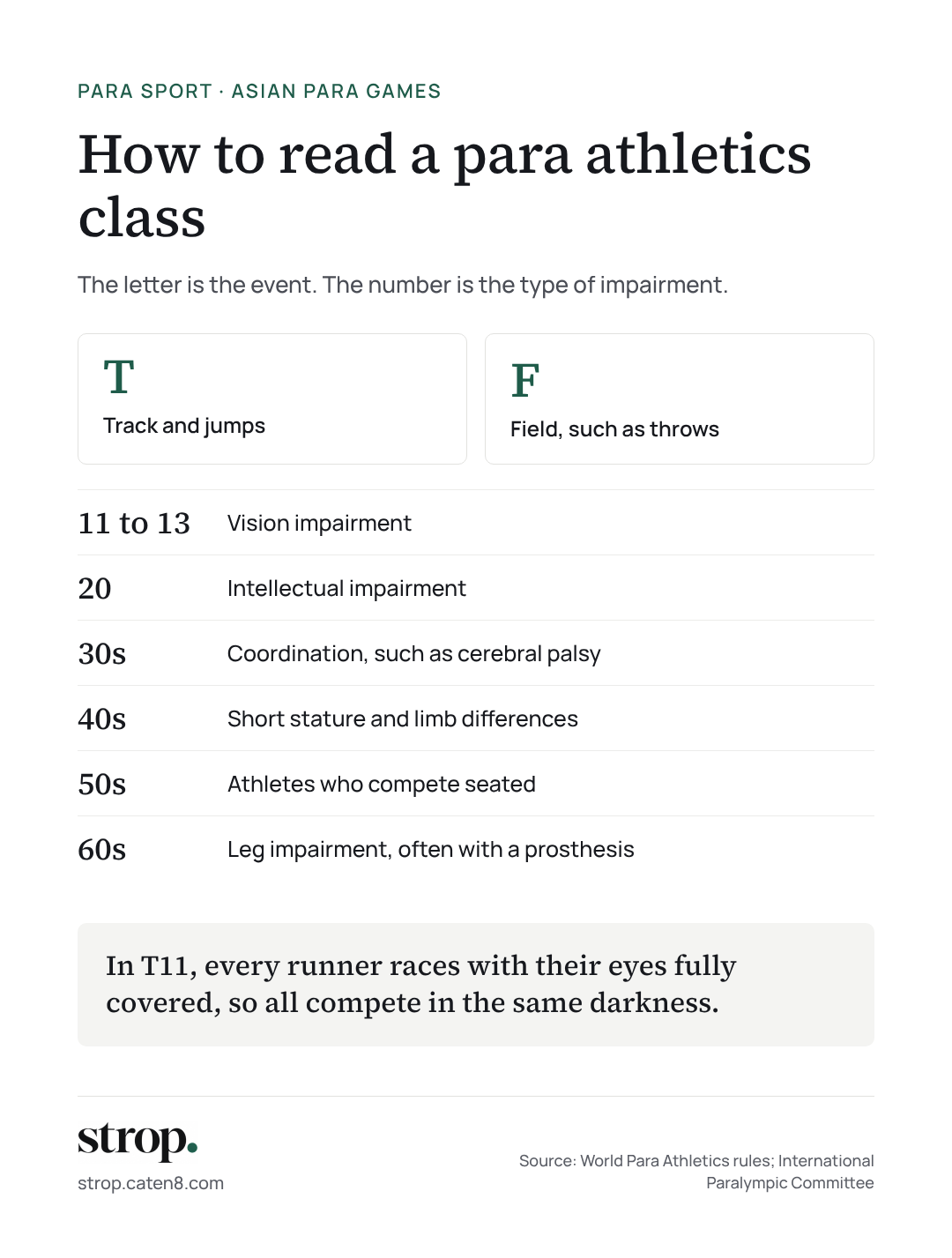
In athletics, the code has two parts. The letter is the kind of event: T for track and jumps, F for field events such as throws. The number is the type of impairment: 11 to 13 for vision, 20 for intellectual impairment, the 30s for coordination, the 40s for short stature and limb differences, the 50s for seated athletes and the 60s for leg impairments.
So when Sumit Antil throws in F64, he is in a field event for athletes with a lower-limb impairment who throw standing. He has won Paralympic gold twice and set a world record of 74.82 metres in May this year.
The class that shows how far the system goes is T11. It is for athletes who are blind or nearly blind, but some of them can still see a little light. To remove even that difference, every T11 runner must race with their eyes fully covered.
Everyone in a T11 final runs in complete darkness, whatever their natural sight.
They also run with a guide, holding a short tether between them. The guide can't pull or push, and the athlete must cross the line first. At recent Paralympics, guides have received medals too.
Is the system perfect? Not quite. Impairments vary so much that two athletes in the same class can be affected quite differently, and a move to another class can end someone's medal chances overnight. At smaller events, classes are sometimes merged when there aren't enough entries.
That's why classification keeps being refined, sport by sport, as researchers learn more about how each impairment affects performance.
Once you know the codes, though, para sport becomes much easier to follow. This week, look out for Avani Lekhara in shooting, Sheetal Devi in archery and Pramod Bhagat in badminton's SL3 class, where the court is half the usual width.