

F1
How did F1's new cars change racing?
18 October 2026
In today's Strop, we explain F1's biggest rule change in over a decade, and why cars now slow down on the straights.
The Story
If you've watched an F1 race on a Sunday night this year, you may have seen something odd: a car flat out on a straight suddenly slowing down for no obvious reason.
That's one side effect of the biggest rule change F1 has had since 2014. It's also part of why Mercedes driver Kimi Antonelli, who is 20, could leave this weekend's United States Grand Prix in Austin as world champion.
So what actually changed?
Start with the engine. Since 2014, F1 cars have been hybrids: a 1.6-litre petrol engine doing most of the work, helped by electric motors. Until last year, roughly 80% of the power came from petrol and 20% from electricity. In 2026 the split moved to roughly half and half.
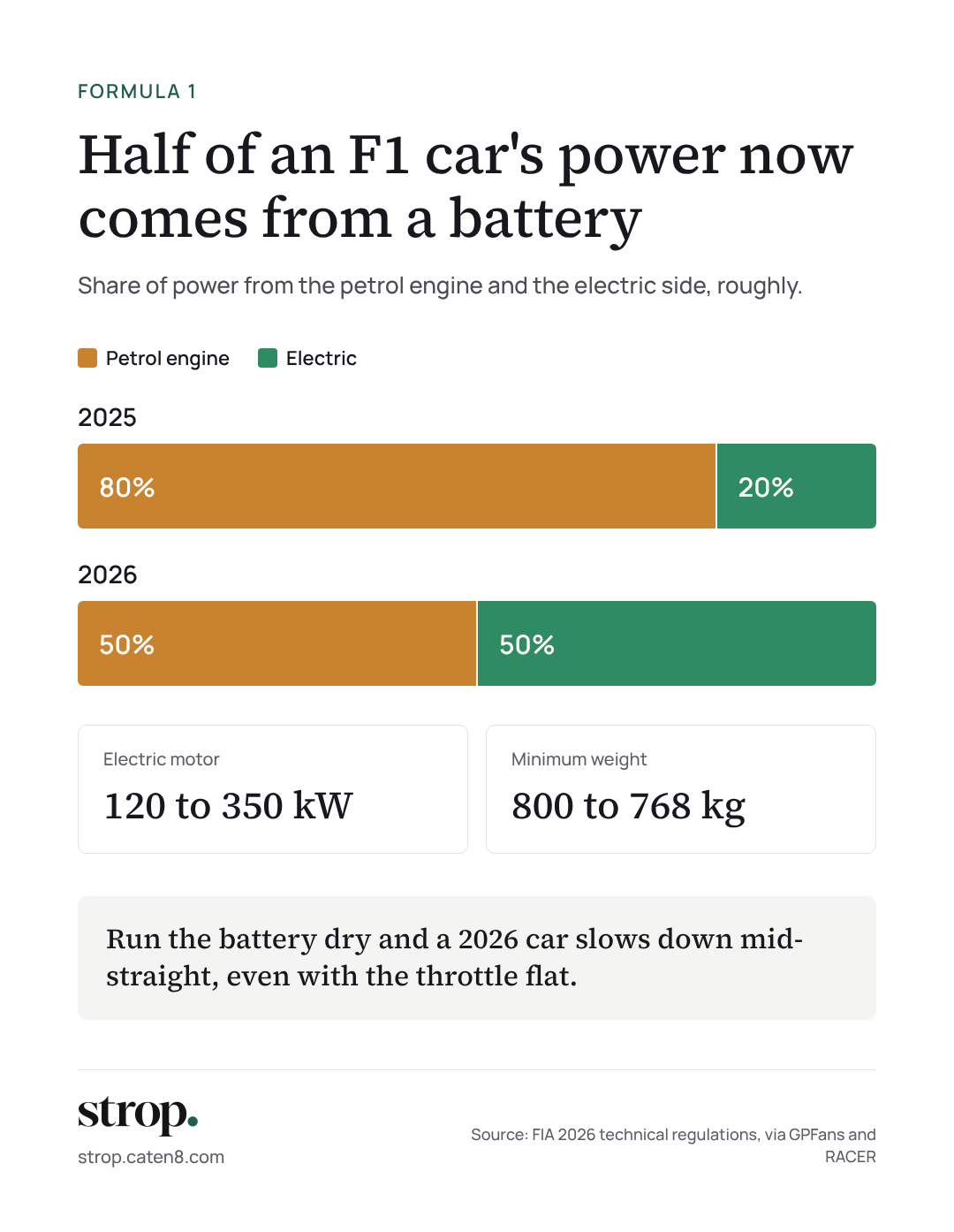
To get there, the main electric motor became almost three times as powerful, rising from 120 kilowatts to 350. That's around 470 horsepower from a battery.
Which explains the odd slowdown. With so much power coming from electricity, a 2026 car can run its battery dry halfway down a long straight. The driver is still flat on the throttle, but about half the power simply disappears. Engineers call it clipping.
Think of a monthly data pack. Burn through it early and the rest of the month crawls. Drivers now manage their battery the same way, lap by lap.
Braking is the main way the cars recharge, so tracks with long straights and few heavy-braking zones are the hardest. Where a driver spends battery now matters almost as much as where they brake.
The bodywork changed too. The cars are shorter, narrower and lighter, with less grip in the corners. The wings now move, opening on straights to cut drag and closing before corners for grip. DRS (a flap on the rear wing that helped overtaking) is gone. Instead, a driver within a second of the car ahead can use overtake mode, a short burst of extra electrical energy.
Not everyone likes it. Several drivers criticised the rules early in the season, partly on safety grounds, since a car that slows suddenly on a straight can catch out the driver behind.
But big rule changes always reset the order, and the team that reads the rules best gets a head start. Mercedes have done this before: after the 2014 change they won eight constructors' titles (the team championship) in a row. After the Singapore Grand Prix, Antonelli leads the championship by 102 points from his teammate George Russell.
If Antonelli wins the title, in Austin or later, he will become the youngest champion in F1 history, beating Sebastian Vettel, who was 23.
The Circuit of the Americas has a long back straight. If you see a car easing off before the end of it, that's usually the battery running low, not the driver lifting.