

Football
What makes El Clásico the biggest rivalry in football?
18 October 2026
In today's Strop, we explain why Barcelona against Real Madrid carries a century of history onto the pitch.
The Story
If you follow football from India, you probably can't name the team fourth in La Liga (Spain's top league). But you know when Barça play Madrid. On Sunday, 25 October, they meet at Camp Nou for the first Clásico of the season, and hundreds of millions of people will be watching.
Plenty of fixtures have great players and big crowds. So why does this one feel different?
Mostly because it was never only about football.
Start with the two cities. Barcelona is the capital of Catalonia, a region in north-east Spain with its own language and a strong sense of being its own place. Madrid is the capital of Spain, home to the government and the royal family. In 1920, the king even let the Madrid club add Real, meaning royal, to its name.
Then came General Francisco Franco, who ruled Spain from 1939 until 1975 and restricted the Catalan language and Catalan institutions.
Think about what that meant in daily life. If you were Catalan, there were very few places where you could gather in large numbers and openly be Catalan. A football ground was one of them. A home match at Barça became a small weekly act of identity.
Historians mostly agree that Franco didn't have a favourite team, but Real Madrid came to be seen as the establishment's club. A few matches sealed that image. In 1943, Barcelona won a cup semi-final first leg 3-0, then lost the return in Madrid 11-1, amid claims that their players had been intimidated before kick-off.
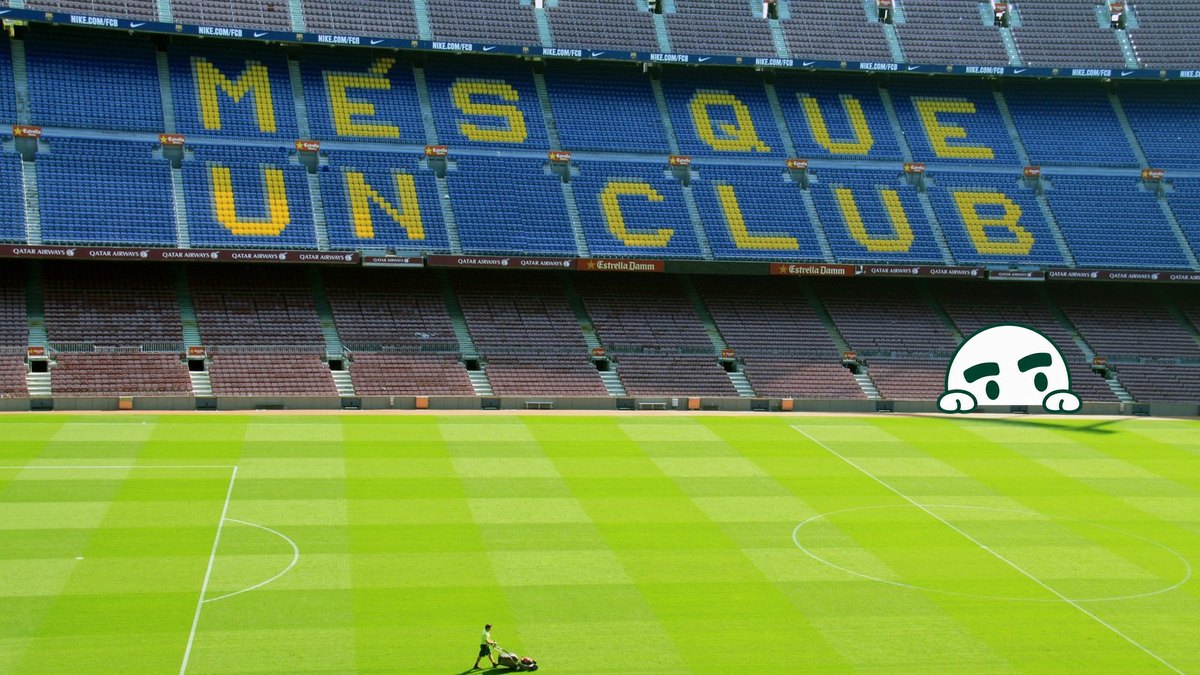
Out of all this came the words spelt out across the stands at Camp Nou: Més que un club, Catalan for "more than a club".
Then there's the money, which is the less famous part of the story and in some ways the stranger one.
Almost every big club in Europe has an owner: an American investor, a Gulf state, a private equity fund. You might wonder which billionaire owns Real Madrid or Barcelona. None does.
Both clubs belong to their members, ordinary fans who pay a yearly fee and vote to elect the club president. When a Spanish law turned most professional clubs into companies in 1990, these two were among only four allowed to stay member-owned.
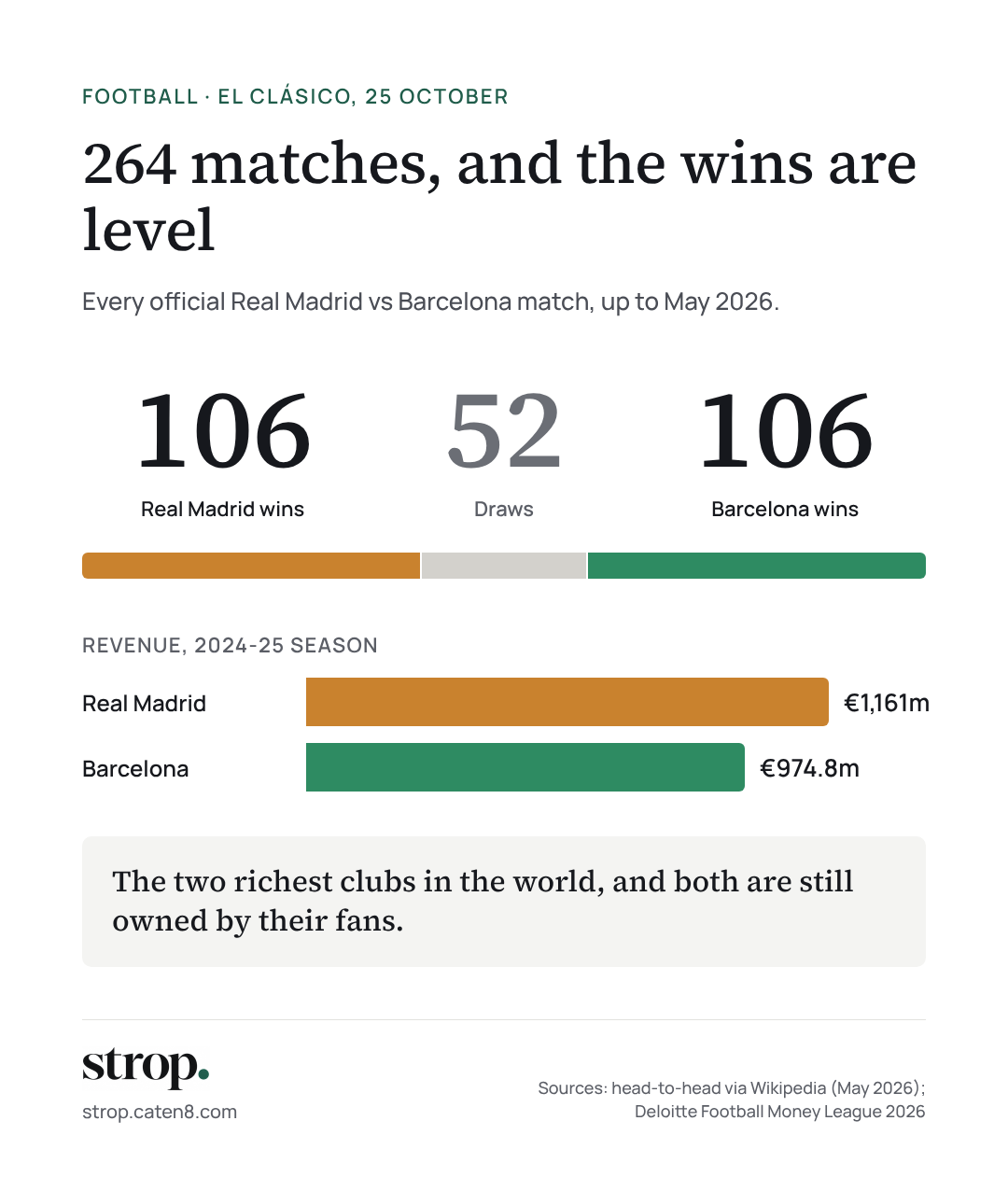
In January 2026, Deloitte (the accounting firm, in its yearly club rich list) ranked Real Madrid as the highest-earning club in the world, with revenue of €1,161 million. Barcelona were second, with €974.8 million. The two richest clubs in football are still owned by the kind of people sitting in the stands.
That sounds romantic, and partly it is. Nobody can buy either club. But there's a catch: nobody can bail them out either.
By 2022 Barcelona were deep in debt, with no owner to cover the losses. So the club sold 25% of its La Liga TV income for the next 25 years to an American firm, Sixth Street, for more than €600 million.
Imagine signing over a quarter of your salary for 25 years to clear this year's bills. That is roughly what Barcelona did.
On the pitch, though, it has stayed remarkably even. In 264 official matches up to May 2026, Real Madrid had won 106, Barcelona had won 106, and 52 had been drawn.
Level, after more than a century.
So will Sunday settle anything? Not the big questions, like Catalonia's place in Spain or whether fan ownership can hold out against clubs backed by states. If Barça win, the money worries fade for a week. If Madrid win at Camp Nou, the old story gets one more line.
Either way, keep an eye on the stands as well as the pitch. That's where most of this history is sitting.